
Black Fiberglass Cloth Faced Glass Wool: The Complete Guide to HVAC Duct Insulation
Every HVAC system has a hidden weakness: the ductwork. Uninsulated or poorly insulated ducts waste energy, sweat condensation, radiate noise, and can become a fire risk. For HVAC contractors, engineers, and distributors, choosing the right duct insulation is not a detail — it is the difference between a system that performs and one that fails quietly.
In this guide, we explain why black fiberglass cloth faced glass wool has become a preferred choice for HVAC duct insulation, what it is made of, how to specify it, and how to install it correctly.
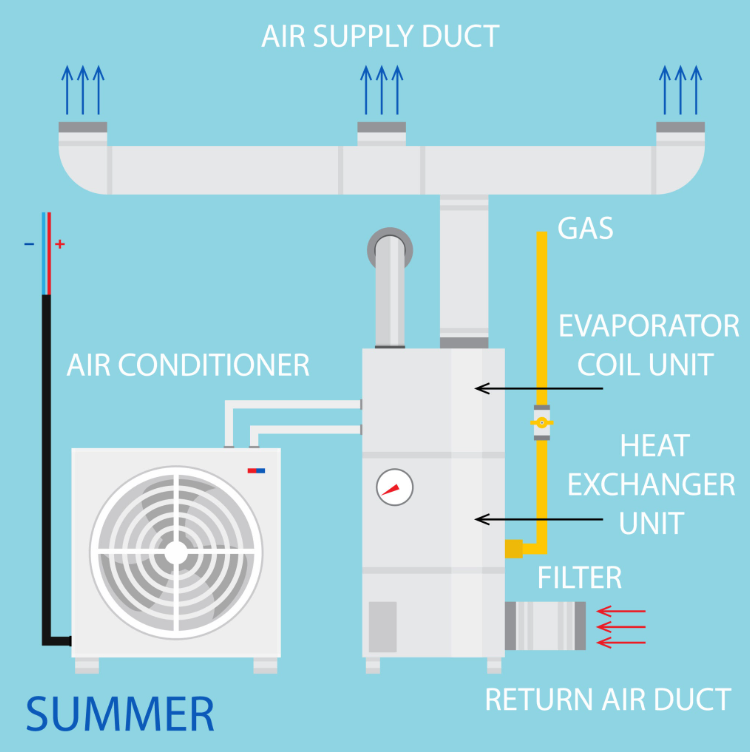
HVAC System Structure and Duct Airflow Schematic. Source: ser_igor / Getty Images
What Is Black Fiberglass Cloth Faced Glass Wool?
Black fiberglass cloth faced glass wool is an engineered composite insulation material consisting of two core components:
· The Core (Thermal & Acoustic Matrix): High-density glass wool blanket or rigid board composed of fine, inorganic glass fibers bonded with thermosetting resin.
· Facing:A high-tensile black fiberglass woven cloth or non-woven tissue hot-laminated onto one or both surfaces.
The black fiberglass cloth facing is what sets it apart from standard aluminum-foil faced glass wool. It offers a clean, non-reflective dark surface, high resistance to tearing and abrasion, and a professional appearance for visible ductwork — which is why it is widely used as duct liner (inside ducts) and duct wrap (outside ducts) in commercial HVAC systems.
Technical Specifications & Performance Indicators
Technical Indicators | Unit | Performance | Standard |
Density | kg/m³ | 24-48 as required | GB/T 13350-2017 |
Thickness | mm | 25-250 as required | EN 13162:2012 |
Reaction to fire | ------ | A1 | EN 13501-1:2018 |
Thermal conductibility | W/(m•K) | 0.032-0.040 | EN 12667 EN 13162 |
Width / Length | mm | Customized | |
Facing | Black fiberglass cloth | ||
Moisture absorption | % | ≤1.20 | EN ISO 29767:2019 |
Key Benefits for HVAC Applications
1. Exceptional Thermal Efficiency & Energy Savings
Glass wool traps still air inside millions of fine glass fibers, creating an effective thermal barrier. Insulated ducts keep heated or cooled air at the right temperature on the way from the AHU to the room, reducing energy consumption and operating cost.
2. High NRC Acoustic Absorption & Noise Suppression
Fan turbulence and air movement create annoying low-to-mid frequency noise inside ducts. The porous structural profile of black fiberglass cloth-faced glass wool acts as an acoustic absorber (NRC up to 0.95), drastically dampening airborne noise transmission inside offices, theaters, studios, and hospital wards.
3. Anti-Erosion Facing for High Velocity Airstreams
When used as an internal duct liner, raw glass fibers can degrade under high static pressure. The bonded black fiberglass cloth facing reinforces the surface, preventing fiber shedding into the airstream at air velocities up to 20 m/s (4,000 fpm) while resisting fungal and microbial growth.
4. Non-Combustible Fire Safety
Safety compliance is non-negotiable. Both the glass wool core and the glass fiber facing are naturally inorganic and non-combustible. The system achieves Euroclass A1 / ASTM E84 Class A ratings, preventing smoke development and flame spread inside ventilation networks.
5. Better Handling Than Foil-Faced Products
· Clean black surface, no glare, professional look for exposed ducts
· Tear-resistant and abrasion-resistant facing
· Easy to cut with a utility knife, wraps smoothly around bends and fittings
· Lighter and more economical than many rigid alternatives
Where to Use It
Black fiberglass cloth faced glass wool is used across the HVAC industry:
Application | How It Is Used |
Supply & return air ducts | Duct wrap (external) or duct liner (internal) |
Plenums & AHU housings | Thermal and acoustic lining |
Cold & hot water pipes | Pipe wrap insulation |
Clean rooms & data centers | Fire-safe, low-dust insulation |
Industrial plants | High-temperature and acoustic insulation |
Installation Guide
1. Measure the duct dimensions (wrap) or internal perimeter (liner)
2. Cut the glass wool with a sharp utility knife; score the facing side first for clean edges
3. Wrap the duct with the black cloth facing outward, overlapping joints by at least 50 mm
4. Seal all seams and penetrations with aluminum foil tape or compatible sealing tape
5. Secure with pins, washers, or banding where required by the specification
6. Safety first: always wear gloves, long sleeves, and eye protection when handling glass wool — the fibers can irritate skin and eyes
FAQ
Q1: Can glass wool insulation be used in high-humidity climates?
A: Yes. When manufactured with hydrophobic (water-repellent) additives and properly sealed along joints, glass wool resists water absorption and prevents moisture-induced thermal degradation.
Q2: What temperature range does it handle?
A: Standard glass wool typically operates from about -50°C to +250°C. Confirm the exact range for your application.
Q3: What is your Minimum Order Quantity (MOQ) and lead time?
Our standard MOQ is one 40HQ container (custom mixed-density loadings supported). Production lead time is typically 7 to 14 days upon order confirmation.
Q4: Do you offer samples for engineering approval?
Yes! We provide free sample for contractors, MEP consultants, and distributors.
Get a Quote Today
If you are an HVAC contractor, MEP engineer, or insulation distributor looking for a reliable factory partner, we would be happy to send you samples, technical data sheets, and a competitive quotation.