

This guide explains how to specifyglass fiber (fiberglass/glass wool) insulation for HVAC ducts, pipes, equipment and acoustic liners, and when other insulation materials should be used instead.
HVAC Insulation Specification at a Glance
A typical commercial HVAC project may use different insulation materials depending on the service and installation environment.
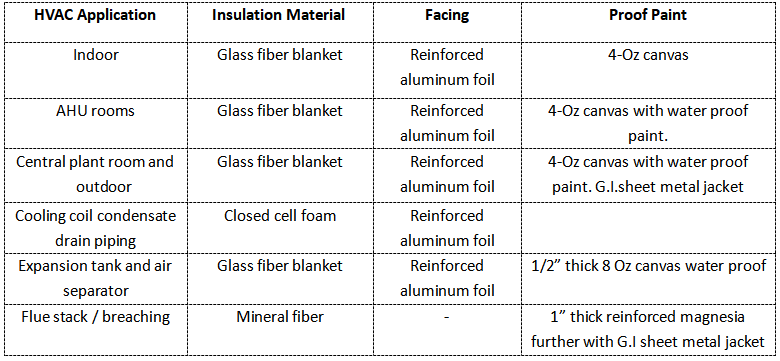
The key point is thatHVAC insulation should be selected according to the service, rather than using one insulation material for every application.
1. What Is the Correct Density for HVAC Glass Fiber Insulation?
One of the most common questions in an HVAC insulation specification is:
What density should fiberglass insulation be for ducts, acoustic liners and pipes?
The answer depends on the application.
Typical Glass Fiber Insulation Density
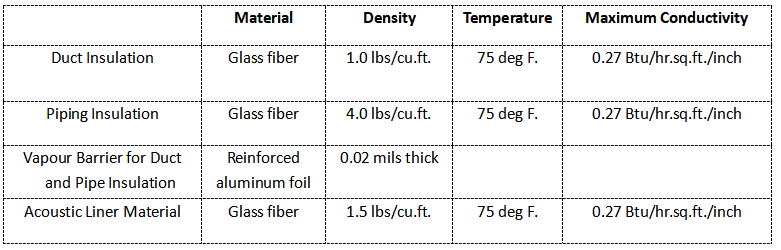
Commercial duct-wrap products demonstrate that density varies by product design and application. For example, fiberglass duct wrap is available at 0.75, 1.0 and 1.5 lb/ft³, corresponding approximately to 12, 16 and 24 kg/m³.
Other mineral/glass wool HVAC products are manufactured at densities around 24–32 kg/m³ for duct applications.
Does Higher Density Always Mean Better Insulation?
Not necessarily.
Density affects the product'srigidity, handling, acoustic characteristics and mechanical properties, but thermal conductivity should be evaluated separately.
For duct insulation, the engineer should specify:
· Density
· Thickness
· Thermal conductivity
· Facing
· Vapor permeance
· Fire classification
· Temperature limitations
· Installation requirements
Therefore,do not select an HVAC insulation product based on density alone.
2. Glass Fiber Duct Insulation: What Should the Specification Include?
Glass fiber duct insulation is commonly installed externally around sheet-metal HVAC ducts to reduce heat transfer and control surface condensation.
A complete specification should identify at least:
1. Insulation type
2. Nominal density
3. Thickness
4. Thermal conductivity or R-value
5. Facing
6. Vapor retarder requirements
7. Fire classification
8. Service temperature
9. Installation standard
10. Mechanical protection where required
For example, commercial fiberglass duct wrap products are available with reinforced foil or FSK-type facings and are specifically designed for exterior insulation of HVAC ducts.
Typical Duct Insulation Thickness
Common commercial specifications include:
· 25 mm (1 inch)
· 38 mm (1.5 inches)
· 50 mm (2 inches)
· Other thicknesses according to project requirements
The required thickness should be determined by the project's thermal-performance and condensation-control requirements rather than by a universal rule.
3. HVAC Insulation Thermal Conductivity: What Does 0.27 Mean?
Thermal conductivity is another critical parameter in an HVAC insulation specification.
A specification may use the imperial unit:
0.27 Btu·in/(h·ft²·°F)
This corresponds approximately to:
0.039 W/(m·K)
at the relevant reference temperature.
However, thermal conductivity should always be compared at thesame mean temperature and according to the same test standard.
For example, commercial mineral wool HVAC products may report thermal conductivity at different mean temperatures, with values changing as temperature increases. One technical data sheet reports 0.033 W/(m·K) at 10°C and 0.041 W/(m·K) at 50°C.
Lower Thermal Conductivity Means Better Thermal Resistance
In general:
Lower λ (lambda) = higher thermal resistance for the same thickness.
But engineers should not compare two insulation products simply by looking at the lowest published λ-value.
Always check:
· Test temperature
· Test method
· Density
· Thickness
· Aging conditions
· Declared vs. measured conductivity
This prevents misleading product comparisons.
4. What Facing Should Be Used for HVAC Duct Insulation?
The facing is an important part of an HVAC insulation system.
It can provide:
· Vapor-retarder function
· Mechanical protection
· Surface durability
· Easier installation
· A finished appearance
· Protection against environmental exposure
Common HVAC Insulation Facings
Facing | Typical Function |
Reinforced aluminum foil | Vapor retarder and protective facing |
FSK facing | Common duct insulation facing |
Black fiberglass cloth | Visible or acoustic applications |
Woven fiberglass fabric | Duct liner / mechanical protection |
Canvas | Protective and finish coating system |
Galvanized steel jacket | Outdoor mechanical and weather protection |
For example, commercial duct-wrap products are available with reinforced aluminum foil and FSK facings.
5. HVAC Vapor Barrier: Why Does It Matter?
For chilled-air ducts and cold HVAC services, the vapor retarder can be just as important as the insulation core.
If humid air reaches a cold surface, condensation may occur.
A properly installed vapor-retarder system helps limit moisture migration into the insulation.
Therefore, for cold HVAC applications, the specification should address:
· Vapor-retarder facing
· Joint sealing
· Lap sealing
· Penetrations
· Insulation continuity
· Surface temperature
· Ambient humidity
· Installation quality
This is why simply specifying "glass wool insulation, 25 mm thick" may not be sufficient for a chilled-water or cold-air application.
6. Acoustic Duct Liner: Does Higher Density Improve Sound Absorption?
Acoustic duct liner is used to reduce noise generated by:
· Fans
· Air-handling units
· Air movement
· Turbulence
· Mechanical equipment
· HVAC cross-talk
The acoustic performance of a duct liner depends on more than density.
Important variables include:
· Density
· Thickness
· Fiber structure
· Facing
· Airflow resistance
· Frequency range
· Installation method
Commercial glass fiber duct liner products are specifically designed for sound absorption as well as thermal insulation. One example reports NRC values ranging from 0.40 to 0.85 depending on the product configuration.
Therefore, an acoustic specification should ideally include the requiredNRC or other acoustic performance criteria, rather than simply stating a density.
Example Acoustic Duct Liner Specification
Glass fiber acoustic duct liner, nominal density approximately 24 kg/m³, thickness as scheduled, with a durable air-stream-facing surface, suitable for HVAC duct applications and complying with the specified acoustic, fire and temperature requirements.
The final specification should be based on the project's applicable standard and manufacturer's tested data.
7. Glass Fiber Pipe Insulation: When Should Higher Density Be Considered?
Pipe insulation has different mechanical requirements from flexible duct wrap.
For piping and mechanical-room equipment, the engineer may require:
· Greater rigidity
· Better dimensional stability
· Resistance to handling damage
· Higher compressive strength
· Appropriate vapor control
· Suitable temperature performance
For this reason,pipe insulation should not automatically be specified using the same density as flexible duct insulation.
Depending on the pipe diameter, temperature, location and jacket system, the appropriate product may be a pipe section, rigid board or another engineered insulation system.
8. Can Glass Fiber Insulation Be Used Outdoors?
Yes, but the insulation system needs appropriate weather protection.
The insulation core itself should not simply be exposed to rain, UV radiation or mechanical damage.
Outdoor HVAC insulation may require:
Glass fiber insulation → vapor/weather-resistant facing → protective jacket
Common protective systems include:
· Aluminum-based weather-resistant facing
· Waterproof coating systems
· Canvas with approved weatherproof coating
· Galvanized steel jacketing
· Aluminum jacketing
For exposed outdoor mechanical equipment, a metal jacket is often specified where mechanical and weather protection is required.
The exact jacket system should follow the project specification and environmental conditions.
9. What Should You Ask a Glass Fiber Insulation Manufacturer?
If you are an HVAC contractor, MEP engineer or distributor, send the manufacturer a complete specification instead of simply asking:
"Please quote fiberglass insulation."
A better RFQ includes:
· Application
· Density
· Thickness
· Width
· Length
· Quantity
· Facing
· Thermal conductivity
· Fire classification
· Temperature requirement
· Jacket requirement
· Packing requirements
· Delivery location
· Required delivery date
Example RFQ
Please quote glass fiber HVAC duct insulation, density 24 kg/m³, thickness 50 mm, reinforced aluminum foil facing, suitable for commercial HVAC duct applications. Please provide thermal conductivity at the specified reference temperature, fire classification, applicable test standards, roll dimensions, packing details, MOQ and lead time.
This format allows suppliers to respond with comparable technical and commercial information.
10.FAQ: HVAC Glass Fiber Insulation
What density fiberglass insulation should I use for HVAC ducts?
Common commercial duct-wrap products are available in approximately 12–24 kg/m³ (0.75–1.5 lb/ft³), but the required density depends on the product, thickness, mechanical requirements and project specification.
What is 0.27 Btu·in/(h·ft²·°F) in W/(m·K)?
It is approximately0.039 W/(m·K).
Always compare thermal conductivity at the same reference temperature and according to the same test method.
Is glass fiber insulation suitable for HVAC ducts?
Yes. Glass fiber/mineral wool products are widely used for HVAC duct insulation, including flexible external duct wraps and duct liner systems. Commercial products are available with reinforced aluminum and other facings.
What is the difference between duct insulation and acoustic duct liner?
External duct insulation primarily addresses thermal performance and condensation control. Acoustic duct liner is installed inside the duct and is designed to provide sound absorption in addition to thermal insulation.
Can fiberglass insulation be used outdoors?
Yes, when it is part of a suitable weather-protection system. Outdoor applications generally require an appropriate weather-resistant facing, coating or metal jacket.
What facing is best for HVAC duct insulation?
There is no single facing that is best for every application. Reinforced aluminum foil and FSK-type facings are common for duct insulation, while acoustic liners may use durable air-stream-facing materials. The choice depends on vapor control, fire performance, mechanical protection and environmental exposure.
What information should I send when requesting an HVAC insulation quotation?
Send the application, density, thickness, facing, thermal conductivity requirement, fire standard, quantity, dimensions and delivery requirements. This minimizes clarification and speeds up technical quotation.
Glass Fiber HVAC Insulation Manufacturer: Request a Project Quote
Have anHVAC insulation specification, BOQ or project datasheet?
Send us the requirements for:
· Duct insulation
· Acoustic duct liner
· Pipe insulation
· Equipment insulation
· Glass fiber blanket
· Glass fiber board
· Reinforced aluminum foil facing
· Custom insulation dimensions
We can review your specification, convertimperial units to metric, confirm available density and facing options, and provide the corresponding technical and commercial information.
Send your HVAC insulation specification or BOQ for a project-based quotation.